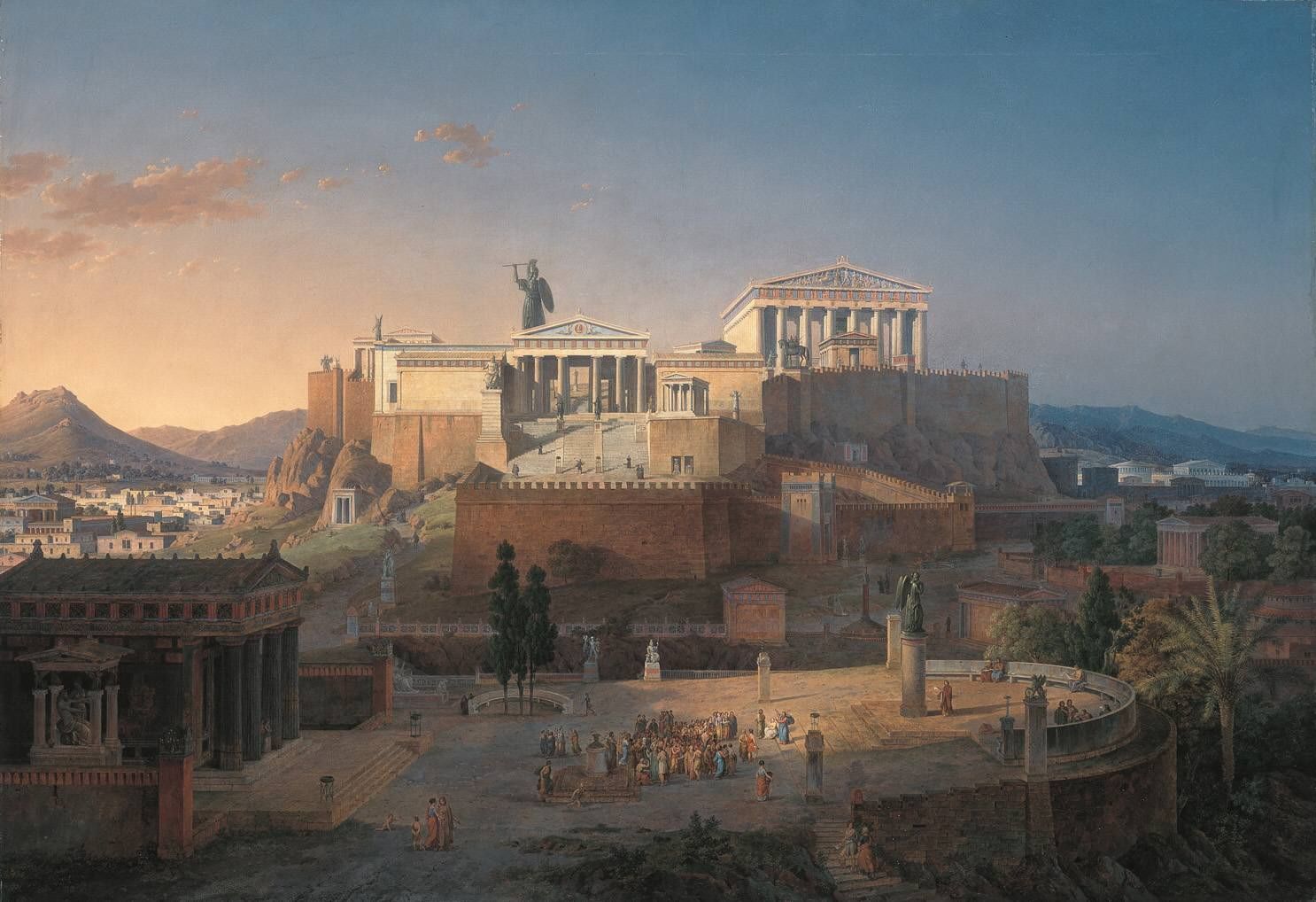
Why Do We Read Mythology? by Jason L., 9th Grade
Greek mythology helps us explore the big questions and stories from ancient cultures, giving us insight into how they viewed the world and what they believed. These myths allow us to examine common human experiences while connecting to Christian thought. Writers like C.S. Lewis and George MacDonald demonstrate how myths play a crucial role in shaping both literature and faith, revealing deeper spiritual truths. In Why Read Pagan Myths, Episode 60 of The Literary Life podcast, myths are explained as more than just stories—they help us understand the world before modern existence. By reading mythology, we can better understand both ancient cultures and the Christian story, seeing how myths influence our culture and traditions.
Originally, myths were passed down orally, through spoken word, before being written. Myths and fairy tales differ in that myths are interconnected, forming a cohesive universe, whereas fairy tales stand as independent stories. For example, Hansel and Gretel and Little Red Riding Hood do not exist in the same world, but myths do. As George MacDonald said, “The imagination of man is made in the imagination of God,” suggesting that human creativity reflects God’s own creative power.
Some Christians may hesitate to introduce their children to myths, fearing they will compete with God and the gospel. However, myths provide valuable perspective, showing the questions people asked in ancient times. They are foundational to storytelling. These stories are older than any written records. As C.S. Lewis noted, we shouldn’t fear similarities between Pagan myths and Christianity. Instead, we should see these parallels as signposts, pointing to the "true myth"—the story of Christ.
Why Should Christians Read Mythology? by Luca S., 12th Grade
As Christians, anything “pagan” or “mythological” might seem unsettling at first. However, we don’t need to be scared off just yet. There is value in mythology. True or false, Christian or pagan, mythology is valuable to every human living in our world today.
Firstly, what is mythology? A secular definition of mythology might sound something like this: “an allegorical narrative” or “a usually traditional story of ostensibly historical events that serves to unfold part of the worldview of a people or explain a practice, belief, or natural phenomenon.” That’s quite a mouthful. C.S. Lewis, arguably one of the most influential writers of the 20th century, defines mythology as “at its best, a real though unfocused gleam of divine truth falling on human imagination.” While the world may look at mythology as a reflection of a society’s traditions and customs, Christians can look at it as a reflection of human nature and our relationship to God. George McDonald, C.S. Lewis’ mentor, once said, “The imagination of man is made in the image of the imagination of God.”
Though humanity is depraved, we were all made in the perfect image of God. God doesn’t specify that only one part of us was made in His image, but that humans as a whole were made in His image. This means that humanity’s brokenness does not discount the image of God portrayed in our imagination. The human mind often fails, but it also points to God and the need for a savior. This theme is an inherent part of the human experience and, as such, is observable throughout the entire history of mankind—especially in myths.
Greek mythology is often the most familiar to modern people. It comes from a society upon which the modern world has founded itself. Whether we recognize it or not, their myths and ideas are all around us. Because of its significance in our society, Greek mythology is a primary candidate for this comparison. Greek mythology and the Christian religion are built around opposing ideas. Christianity centers itself around God, with humanity as His creation, meant to love and be loved by Him. Greek mythology centers itself around the universe and “Mother Earth.” In the Greek tradition, all the gods were made in the image of humanity, by the earth and the sky. This belief system revolves around man, while the Christian belief system revolves around God.
The great differences between Christian mythology and Greek mythology might seem counterintuitive at first, but they actually emphasize the nature of human imagination. The significance of this dichotomy is that there is very little, if any, parallel. The Greek mythological universe is a perfect example of humanity’s attempt at finding creation, purpose, and god within themselves. Left to our own devices, humanity filled the void of godlessness with their own idolatrous images. The Greeks created their gods rather than being created by them. Humans yearn for a creator, for a purpose, but we are also selfish. We want to be made by us and for us, not for someone or something much greater than we could ever imagine. In this way, the reality of mankind’s imagination pointing to God simultaneously reveals the need for a savior.

Genesis of the Greek Gods, a retelling by Aurora P., 9th Grade
The earth was barren for a long time, until Gaea, the Earth herself, came into existence. She was lonely, so she looked into the sky and saw Uranus, the Sky, watching over her. She fell in love, and together they had many children. The first of these were the Cyclopes, one-eyed giants. However, Uranus was disgusted by his children and cast them into Tartarus, the deepest part of the underworld.
Soon after, Gaea gave birth to more children: the Hecatoncheires, beings with a hundred heads and a hundred arms, whose name means "Hundred-Handed Ones." But Uranus still rejected them, banishing them to Tartarus as well. Weary of Uranus's cruelty, Gaea decided to take action. She gave her son, Kronos, a sickle and sent him to confront his father. Kronos used the sickle to castrate Uranus, leaving him humiliated.
Kronos then married the Titaness Rhea, and they had children together. But fearing that his own children might one day overthrow him, as he had done to his father, Kronos devoured each one as soon as they were born. When Rhea became pregnant with their sixth child, she couldn’t bear to watch another of her children be eaten. In secret, she gave birth and tricked Kronos by handing him a stone wrapped in baby clothes. She hid the child, Zeus, with two women and a goat, while the women clashed their weapons to drown out his cries.
When Zeus grew up, he killed the goat and gave its horns to the women as a gift. He then sought out his grandmother, Gaea, who urged him to free his uncles and aunts from Tartarus, as Kronos had failed to do. Instead, Zeus approached Kronos and tricked him into consuming an herb that caused him to vomit up Zeus’s fully grown siblings. Despite this, Zeus still did not release the Cyclopes and Hecatoncheires. He established his siblings as the rulers of Olympus, a mountain so tall that mortals could not enter, which had been built by the Cyclopes.
Zeus assigned each of his siblings dominion over different realms. He became the chief ruler of Olympus. Hades was given the underworld, and Poseidon became god of the oceans. Hera was made Zeus's wife and goddess of marriage and childbirth, while Hestia became the virgin goddess of the hearth. Aphrodite, goddess of love and beauty, was born from the sea foam created by the severed parts of Uranus.
Zeus’s children were born in unique ways. Athena, the goddess of wisdom, sprang fully grown from Zeus’s head after Hephaestus split it open with an axe to relieve a headache. The twins Artemis and Apollo were born on a remote island after Hera, jealous of their mother Leto, tried to prevent their birth. Artemis became the goddess of hunting, while Apollo became the god of music and dance. Dionysus, the god of wine and festivity, had an unusual birth as well. When Zeus's lover Semele doubted his divinity, Zeus revealed his true form, accidentally burning her alive. He saved the unborn Dionysus by placing him in his thigh, where he continued to develop.
Heritage Highlights:
"Pagan myths form the foundation of many cultures, particularly Western civilization. Greek and Roman myths, for example, have significantly influenced philosophy, literature, and art throughout history. By reading these stories, we gain valuable insight into the beliefs, values, and worldviews of ancient societies. Mythology has also inspired countless works of literature, art, and music. From Shakespeare to modern novels, references to mythological figures and themes are common. Understanding mythology helps readers interpret and appreciate these allusions in both classic and contemporary works."-Luxuan S., 9th Grade International Student
"Myths reflect universal aspects of human nature. In both Greek and Chinese mythology, we see people wrestling with power, justice, and fate—struggles that continue to resonate today. These stories provide insight into how ancient peoples understood their own challenges and the world around them. While myths explore the divine, they often present gods who are distant or flawed. In both Greek and Chinese myths, gods are sometimes selfish or violent. In contrast, the Bible reveals a God who is perfect, just, and merciful. The biblical narrative of creation, redemption, and restoration stands in stark contrast to these mythological depictions of deities. By studying myths, Christians can see how humanity has long searched for meaning and how the Bible offers a complete and redemptive story of God's plan. Christians should study mythology because it deepens understanding of different cultures, human nature, and the search for truth. By engaging thoughtfully with these stories, Christians can address contemporary issues while pointing to the ultimate truth found in Scripture."-Anthony C., 12th Grade
"Myths, while playing a huge part in our education, also serve a much larger purpose in helping us understand ourselves and others. They can be seen as collections of stories that offer insights into human nature and provide a deeper understanding of the world around us. Rather than simply presenting “false realities,” as some might believe, myths help us explore the complexities of life across centuries." -Alex A., 12th Grade
"Reading pagan mythology is fascinating because it opens a window into the beliefs and values of ancient cultures. These myths are filled with epic tales of gods and heroes that explore deep themes like love, nature, and the meaning of life. By studying them, we gain insight into how different societies understood the world and their place in it. It’s also a great way to appreciate the diversity of human thought and creativity. Plus, these stories can inspire our own writing and help us think critically about our beliefs. Overall, diving into pagan mythology can enrich our understanding of history and the connections between cultures." -Kenya S., 9th Grade
"Reading the Greeks' thought process about how the world was formed through Chaos can help us understand our human nature. Learning myths can tell us more about ourselves in how humans tell stories to explain their thoughts. Myths are stories about culture, and we should start by reading these myths to understand history. As George MacDonald said, 'We must not be ashamed of the mythical radiance resting on our theology.'" -Ella B., 9th Grade
"Where do we come from? What are we? Where are we going? These three questions have puzzled humanity for centuries. While we can make hypotheses, proving them is beyond our reach. Because of this uncertainty, people throughout history have made many guesses about the origins of the world and the meaning behind natural phenomena. Some of these guesses were woven into stories that we now call "mythology." Some might dismiss myths as mere products of the author's imagination. However, myths are distinct from novels because they incorporate not only creativity but also ancient observations about the world. Myths are not purely imaginative; they also reflect how ancient people interpreted the world around them. Myths are more than just fantastical tales; they serve as a window into the ancient world. Through this window, we gain valuable insight into ancient worldviews, beliefs, and ideas, allowing us to better understand the people who came before us." -Thales G., 12th Grade
"Myths help us discern something of human nature. They deal with very real issues, such as the struggle for power and questions of justice." -Mani G., 12th Grade International Student
“060: Why Read Pagan Myths.” The Literary Life, hosted by Angelina Stanford, 23 Mar. 2023, theliterary.life/060/.
Ben House. *Veritas Omnibus: Mythology*. Veritas Press, 2009. D'Aulaire, Ingri, and Edgar Parin D'Aulaire. *Ingri and Edgar Parin D'Aulaire's Book of Greek Myths*. Doubleday. Hamilton, Edith. *Mythology: Timeless Tales of Gods and Heroes*. Little, Brown and Company, 1942. Lee, Archie C. C. *The Chinese Creation Myth of Nu Kua and the Biblical Narrative in Genesis 1-11*. Brill, 1994.


No comments:
Post a Comment
Note: Only a member of this blog may post a comment.