
Trees are symbolic figures across the world. To me, they specifically connect three ideas: Jesus Christ as humanity’s salvation, the relationship between man and nature, and the symbolism of people—both in life and in personality—as trees.
In the Bible, trees are consistently referenced in a symbolic manner. From the fall of man to the tree Christ died on, they are always present. An important metaphor in Scripture is the comparison of humanity to trees. Jeremiah 17:8 equates God’s goodness to a nourishing stream that gives life to the tree planted nearby, symbolizing the Christian. Later, in the book of John, Jesus shares with His disciples, “I am the vine; you are the branches. If you remain in me and I in you, you will bear much fruit; apart from me, you can do nothing.” Jesus is the Tree of Life from which we are meant to draw life.
Jesus’ role as the Tree of Life has always been symbolic, but it was also a material reality. When Jesus died on the cross, He revealed Himself to us as the Tree of Life in the ultimate way. The Fall came through Adam and Eve disobeying and taking from the Tree of the Knowledge of Good and Evil, but our salvation comes from the good fruit we receive from Christ. This symbolism of trees as the root of life is a fascinating depiction that can be found across different cultures worldwide. In Norse mythology, Odin sacrifices himself by hanging from Yggdrasil, their Tree of Life. In the Native American creation myth of the Iroquois, life on Earth comes from the seedlings of the great Tree of Life. Likewise, in the biblical creation story, man’s brokenness is attributed to the fruit of a tree, and salvation is brought by the fruit of another tree. Through Jesus’ sacrifice on the cross, humanity is offered the fruit of life from the ultimate Tree of Life. This concept is further explored in Seamus Heaney’s poem, St. Kevin and the Blackbird.
Heaney’s poem St. Kevin and the Blackbird highlights the connection between man, nature, and God. It begins with St. Kevin in his jail cell, which is so small he cannot stretch out his arms. When St. Kevin goes to pray in the traditional Celtic way, with his arms outstretched in a pose resembling Christ on the cross, he must stick one arm out of the cell’s window. In this moment, he becomes a symbol of Christ’s crucifixion and the Holy Tree that saved humanity. St. Kevin prays for what seems to be weeks, long enough that a blackbird comes to build a nest on his outstretched arm, transforming him into a symbol of the material trees that grow on Earth. Through this image, Heaney connects Christ to humanity and humanity to nature, showing how God designed the universe to work as one. Although sin broke this harmony, God’s love for us is so great that He gave us redemption through Christ.
Trees are a part of everyday life and can often seem ordinary, but they can mean so much more! In the creation story of Genesis, trees represent the Knowledge of Good and Evil and the corruption of man. In Jesus, the Tree of Life symbolizes salvation, offering humanity redemption from the original sin of eating from the Tree of Knowledge. From the beginning to the end of God’s plan, trees have been integral symbols. Psalm 1:3 says, “That person is like a tree planted by streams of water, which yields fruit in season and whose leaf does not wither—whatever they do prospers.” For humanity, being rooted in Christ and His goodness is a life-giving source. Jesus is the Tree of Life, the most incredible gift from God.
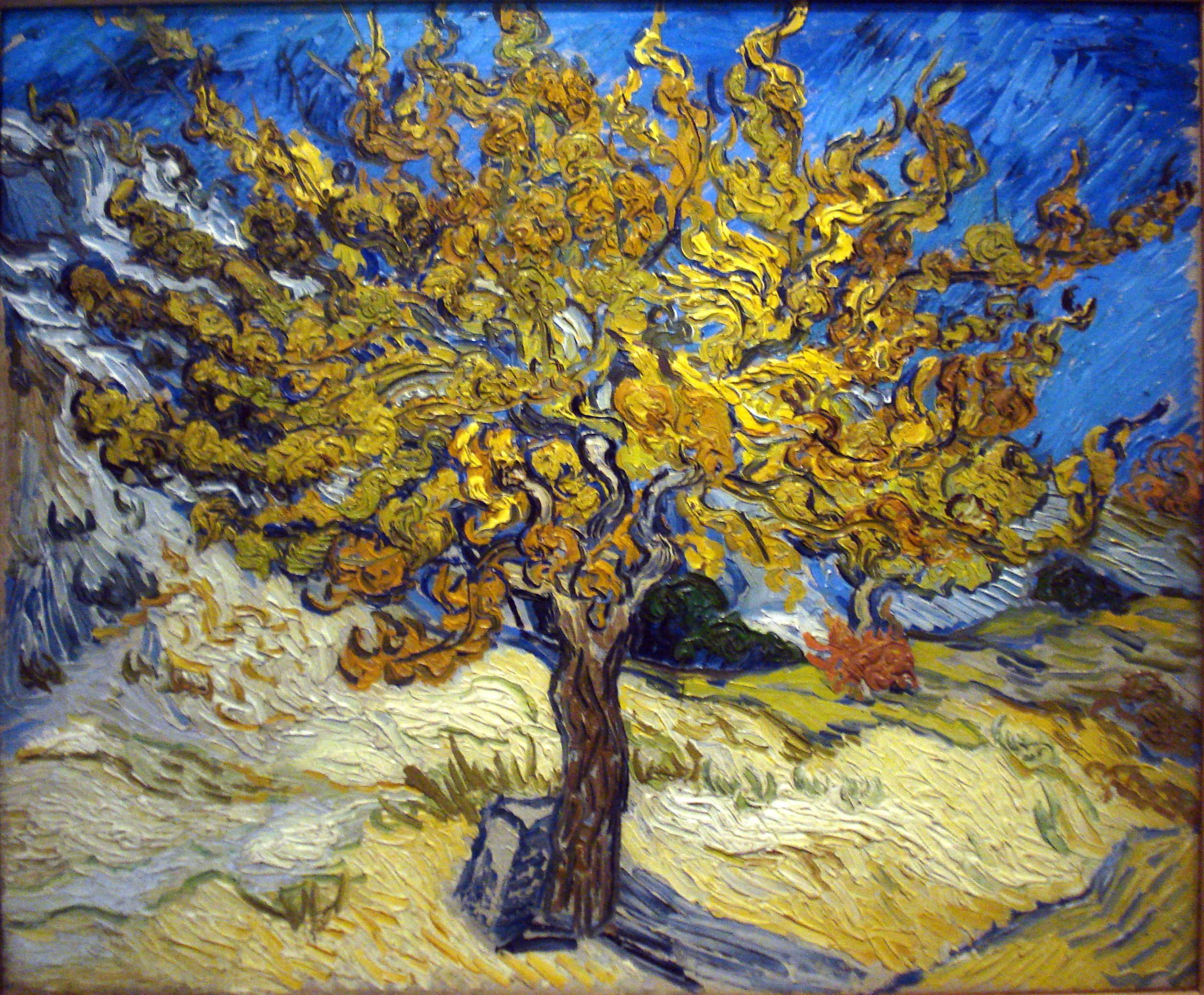 Van Gogh, V. (1889). The Mulberry Tree [Oil on canvas]. Wikimedia Commons.
A Deep Kinship With Trees by David C., 10th Grade International Student
In the hustle and bustle of life, I sometimes feel like a tree—rooted in place, quietly observing the world while remaining deeply connected to everything around me. Trees stand silently, harmoniously coexisting with nature. Their presence, though humble, plays a vital role in shaping the environment. In many ways, they embody qualities I strive for in my own life. Here are a few reasons why I feel a deep kinship with trees:
- Strong RootsTrees have deep roots that anchor them firmly to the ground, allowing them to stand tall even through the harshest storms. Similarly, I strive to cultivate a strong foundation in my life. My values, principles, and the relationships I build are the roots that keep me grounded, no matter how turbulent life becomes. Just as trees draw nourishment from the soil, I draw strength from my inner convictions and the support of those around me.
- Growth Through LifeTrees undergo cycles of growth, from tender saplings to towering giants. Each season brings new challenges—cold winters, blossoming springs, harsh summers, and fruitful autumns. In my own life, I am constantly growing and evolving through each season of experience. The challenges I face help me develop resilience, and like the rings inside a tree trunk, they become markers of my growth. Each experience, whether good or bad, adds to my maturity and understanding, shaping me into the person I am becoming.
- Harmony with the EnvironmentA tree is never isolated; it exists in harmony with its surroundings. It provides shelter, shade, and oxygen, and in return, it depends on the sun, rain, and soil to thrive. In my own life, I recognize the importance of living in harmony with others and my environment. I aim to contribute positively to the world around me, supporting friends, family, and even strangers while understanding that I, too, am shaped by those I interact with. We are all interconnected, much like a forest, where each tree plays a role in the health of the whole ecosystem.
- Sharing and GivingTrees are generous by nature. They provide shade, bear fruit, and offer a home to countless creatures. I, too, hope to embody this spirit of giving. Through my actions, I want to offer support, kindness, and positivity to others. Whether through sharing knowledge, lending a helping hand, or simply being a source of comfort, I aim to give back in ways that uplift those around me, just as a tree enriches its environment with its offerings.
- Calm and ResilienceTrees stand firm through storms, enduring winds, rain, and sometimes even lightning. They may lose branches or leaves, but they remain rooted and continue to grow. In the same way, I strive to remain calm and resilient when faced with life’s difficulties. Adversity will always come, but I believe in standing tall, facing challenges head-on, and growing stronger from them. Like a tree that bends but does not break, I aim to adapt and recover, emerging more resilient after each storm.
Through this metaphor of the tree, I am reminded that strength, growth, and resilience do not require loud declarations. Sometimes, the most profound impact comes from standing quietly and deeply rooted in one’s principles, contributing to the world in subtle but meaningful ways. Just as trees contribute to the ecosystem around them, I hope to live my life with purpose, offering stability, growth, harmony, and care to those around me, all while staying rooted in my own essence.
 Trees as a Significant Archetype for Human Life by Alex. A, 12th Grade Student
Trees have carried deep symbolism throughout human history, appearing in literature, art, and scripture as a significant archetype for human life. From the Bible to poetry, trees are frequently used to illustrate our connection to life, growth, and change. Their relevance to human existence can be traced back to the Bible, where they represent life, knowledge, and spiritual development. Trees symbolize human growth, evolution, and resilience. Just like trees, humans grow and adapt over time, their roots reflecting the experiences that shape their lives. As seasons change, both trees and people bear the marks of time’s impact, symbolizing the stages of growth and transformation.
Trees play a significant role in the Gospel, appearing in important events laden with symbolism. From Eve’s consumption of the forbidden fruit to Moses’ encounter with the burning bush, trees have consistently held meaning beyond their physical form. Rather than serving as random symbols, scripture uses trees to convey deep truths, such as in the Tree of Knowledge, representing good and evil. Jesus Himself draws a parallel between trees and human beings: “I am the true vine, and my Father is the gardener” (John 15:1). As reflections of Christ, we, like trees, grow through God’s guidance and teachings.
Trees serve as a powerful archetype due to their profound relatability to human life. Like us, trees grow, age, and change. They represent both the strength of maturity and the frailty of aging. Trees remind us that even though we may exist in abundance, each of us grows and thrives in our own unique way. In many cultures, trees symbolize life itself. “Then the Good Mind was satisfied, and he pulled up a tree and saw water fill the cavity where the roots had been… Like unto that I will make men-beings” (How the World Began, 16). Trees, like humans, rely on sustenance—water, food, and care—to flourish, making them a fitting symbol for human growth and endurance.
Though trees are everywhere, no two are exactly alike. Each tree, much like every person, has its own roots, background, and story. “And so, too, do your roots. Histories, memories, desires, and connections run through the veins of each individual, shaping how they act and move in the world” (Clarkson, 44). Our roots—our histories, connections, and experiences—shape who we are. Just as trees don’t choose where they are planted, we don’t control the circumstances of our birth. However, our ability to grow, change, and become unique individuals is what makes both trees and humans remarkable. The diversity among trees, much like the diversity among people, underscores why the Bible often uses trees as an archetype for life’s journey.
In conclusion, the tree has long been a potent metaphor for human life, reflecting the significance of time, growth, and patience. Trees symbolize the seasons of life, where growth and transformation occur as we are nourished by Christ. "That person is like a tree planted by streams of water, which yields its fruit in season and whose leaf does not wither—whatever they do prospers” (Psalms 1:3). This seasonal growth reflects our relationship with God, who nurtures us through life's challenges and triumphs. Personally, trees remind me that it’s not about fitting in but about growing into who I am through my relationship with Christ, which truly defines my character.
Sources Cited:
- Gospel of John. New International Version, Zondervan, 2011.
- BJU Press, American Literature: How the World Began.
- Clarkson, Joy Marie. People Are (Not) Trees. Bethany House, 2024.
- Book of Psalms. New International Version, Zondervan, 2011.
 Kandinsky, W. (n.d.). Tree of Life [Oil on canvas]. Wikimedia Commons. https://commons.wikimedia.org/wiki/File:Wassily_Kandinsky_Tree_Of_Life.jpg
"Like trees, people need strong roots to keep them grounded. Roots represent the elements that provide us with stability, such as our families, friends, values, and life experiences. Just as trees absorb nutrients from the soil, people gain strength from their relationships and past. When our roots are deep and healthy, we can remain steadfast, even when life becomes challenging. Similarly, people are like trees in the way their branches extend and grow in different directions. Branches symbolize the ways in which we expand—through forming new relationships and exploring opportunities. Just as trees rely on sunlight to thrive, people need connection to feel alive and supported. As we extend our branches by learning new things or meeting new people, we not only grow ourselves but also contribute to the growth and support of others, creating a shared network of strength." -Anthony C., 12th Grade International Student
"Psalm 1:3 compares a good person to a tree planted by water, which helps us understand how we can grow when we are connected to God and good values." -Mani G., 12th Grade International Student
"The drama of humanity's connection with God is depicted in these moments by the silent witness of trees- times of decision and desperation, fidelity and sin, and passing or failing the temptations of life." -Nic V., 12th Grade


No comments:
Post a Comment
Note: Only a member of this blog may post a comment.